Paint decontamination: what washing won't lift
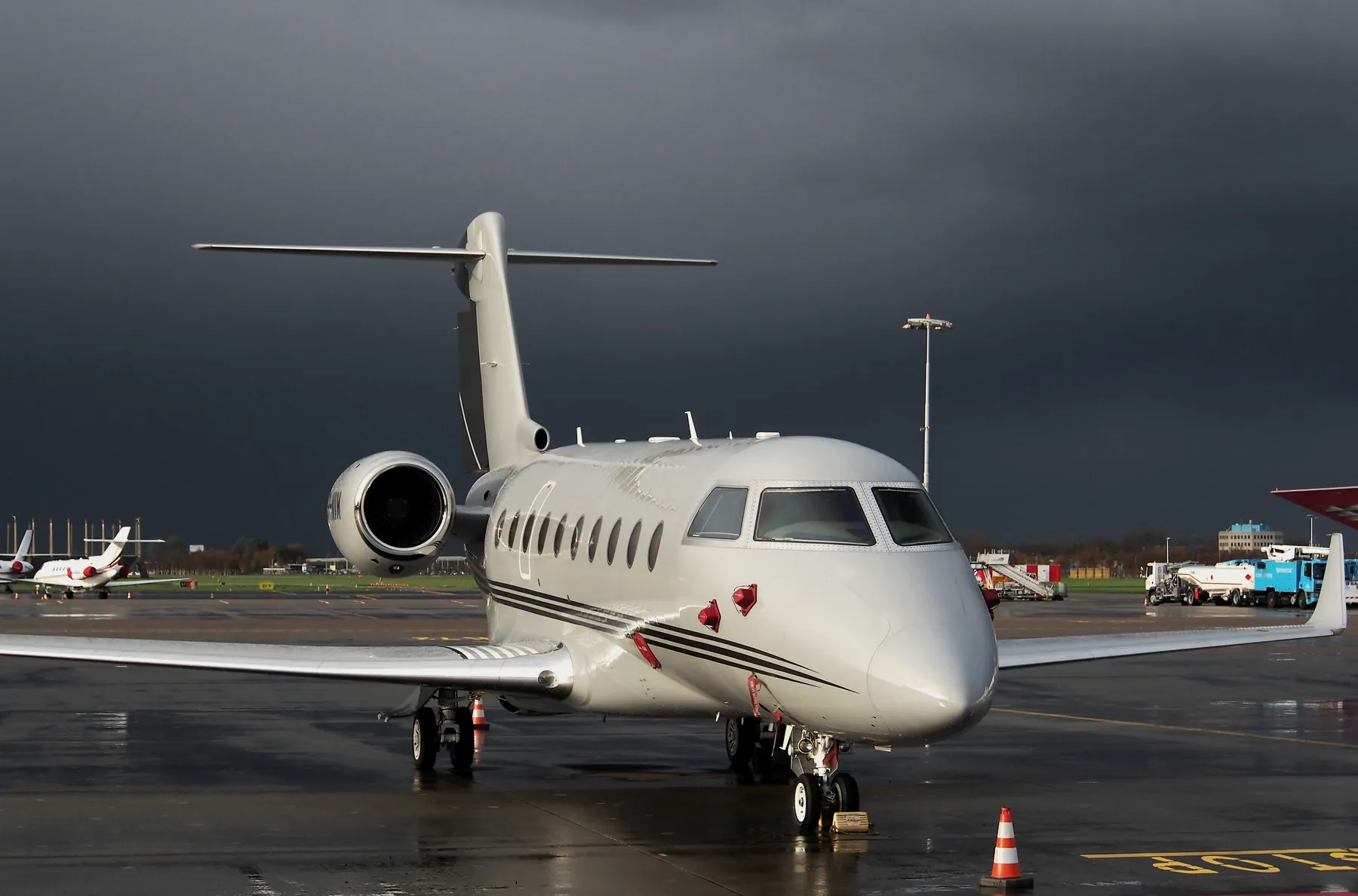
An aircraft can come off a wash rack looking correct and still carry a measurable load of contamination in the finish. The paint is clean. The paint is not decontaminated. Those are different conditions, and the difference is where a great deal of avoidable cost lives.
Washing is a surface operation. It lifts what sits on top of the clearcoat: soil, film, loose particulate, material that has not chemically or mechanically attached itself to the paint system.
Decontamination addresses what has. Different problem, different chemistry, different mechanics, and no amount of additional washing solves it.
The test that settles it
Run a clean hand across a freshly washed upper wing surface. Then place your hand inside a thin plastic bag and run it across the same panel again.
The bag removes the fingertip's ability to compensate. What felt smooth registers as granular. A faint, uniform grit across a surface that looks flawless. Those are particles held above, in, and slightly below the plane of the clearcoat. They did not come off in the wash and they will not come off in the next one.
On an aircraft based in a coastal or industrial environment, that texture is normal. Its absence would be the unusual finding.
What is actually bonded to the finish
Contamination on a business aircraft falls into two categories, and they fail differently.
Mechanically embedded particulate. Ferrous material dominates: wear product from the aircraft's own brakes, from ground support equipment alongside it, and from the industrial fallout that settles across any airfield. These particles arrive hot or arrive sharp, and lodge in the clearcoat rather than resting on it.
Once embedded, they oxidize. Iron oxide occupies more volume than the parent metal, so each particle exerts outward pressure on the clearcoat around it as it corrodes. The result is a network of microscopic stress points, each a path for moisture to reach what is underneath. Where the finish is already thin, at panel edges, fastener heads, and areas worked by UV degradation and thermal cycling, that pathway is short.
Chemically bonded film. This is the broader group:
- Exhaust residue across the aft fuselage and empennage, acidic in the presence of moisture
- Chloride deposits from marine air, hygroscopic, drawing moisture to the surface long after the aircraft is dry
- Mineral deposits from evaporated rain and hard rinse water, bonded rather than dried on
- Bug strike protein on leading edges and radome, acidic and actively etching
- Hydraulic fluid, engine oil, and de-ice fluid residue, each with its own solvency requirement
- Rubber transfer on gear doors and belly panels from tire scrub at touchdown
- Tree sap and pollen on aircraft that sit outside between trips
None of these is soil. Every one of them requires a specific chemistry to release, and several of them are actively working on the paint system while they remain.
Two operations, not one
Paint decontamination is chemical and mechanical, in that order.
The chemical stage targets the bonded material. Ferrous contamination responds to a chelating chemistry that dissolves iron oxide in place. The reaction is visible as a violet bleed drawing down the surface, and it is the clearest confirmation available that embedded metal was present. Organic films release to alkaline chemistry. Mineral deposits require an acidic approach, which on an aircraft is the most restricted operation of the three.
The mechanical stage addresses what chemistry cannot reach. Engineered clay media, run under heavy lubrication, shears embedded particulate off above the clearcoat plane. It is a controlled abrasion and it should be understood as one: clay leaves some degree of marring on any finish, which is why it is sequenced ahead of paint correction and never used as a finishing step on its own.
Why this is harder on an aircraft
The chemistry is not the difficulty. Placement is.
An airframe is not a continuous painted surface. It is paint interrupted by fasteners, lap joints, fillet-sealed seams, drain paths, bonded composite panels, unpainted alloy, anodized fittings, acrylic transparencies, static wicks, and sensors that must not be touched by anything.
Capillary action does not respect a technician's intent. Chemistry applied to a panel will migrate into the seam at its edge, and a seam is precisely where rinsing cannot reach and where corrosion initiates. Decontamination chemistry left in a lap joint is not a cleaning step. It is a corrosion mechanism with a delay on it.
That is what governs the work in practice: controlled dwell, no chemistry permitted to dry on the surface, masking of ports and sensors before anything is applied, deliberate management of where rinse water travels, and a hard boundary at every unpainted and dissimilar-metal surface on the airframe.
It is also why decontamination belongs in a controlled environment rather than on an open ramp. Chemistry with a defined dwell window does not tolerate direct sun, wind, or a surface temperature the technician does not control.
The step that decides what your coating is worth
This is the part that reaches the operating budget.
A ceramic coating bonds to the surface it is applied to. If that surface carries embedded ferrous particulate and a chloride film, the coating bonds to the contamination, not to the clearcoat. Two things follow. Adhesion is compromised across the coated area, shortening service life against every figure the system is rated for. And every contaminant present at application is now sealed beneath a bonded layer that was engineered specifically to resist removal.
An owner in that position has paid for protection and permanently captured a set of corrosion initiation sites underneath it. Correcting it later means removing the coating to reach what it covered.
The same logic governs paint correction. Polishing a contaminated surface drives embedded particulate through the clearcoat under pad pressure, converting a contamination problem into a defect problem on a finish that has a finite number of corrections left in it.
A secondary effect is worth noting. Contamination raises surface roughness across the wetted area, and roughness drives skin friction. That is a parasite drag penalty whose magnitude varies too widely by airframe to state usefully, though its direction does not.
What it does not do
Paint decontamination is not paint correction. It removes what is bonded to and embedded in the finish. It does not remove swirl marks, oxidation, or scratches. Those are defects in the clearcoat itself, and they require abrasive correction.
Nor is it a scheduled item in the way a wash is. Frequency follows the operating environment. A coastal aircraft accumulates chloride faster than an inland one, and a high-cycle aircraft accumulates brake product faster than one flying long legs. The gating rule is what stays constant: decontamination precedes any coating application and any correction work, without exception, because both are permanent with respect to whatever is on the surface when they begin.
Where this starts
Whether your aircraft needs decontamination, and how much, is a condition question rather than a schedule one. It depends on where the aircraft is based, how it is flown, what is on the finish now, and how much clearcoat is left to work with.
That is what The Premier Assessment is for. We look at the aircraft in person, read the finish inside and out, and give you an honest picture of what is achievable, with no obligation. What follows is a written, aircraft-specific scope delivered to your preferred contact, so you have the detail in hand before anything is scheduled and before anyone touches the airframe.
Call (888) 580-9080 · Text (619) 604-9503
© 2026 PREMIER AVIATION VENTURES LLC. All rights reserved. Brown Field Municipal Airport (KSDM) · San Diego, California
Registered office: 1401 21st Street, Suite R, Sacramento, California 95811
Aircraft detailing and appearance services. Ceramic coating certifications as applicable to airframe type. Complimentary assessments offered by appointment.