Can't the line crew just wash it?
It is the most reasonable question an owner asks, and it usually comes with a fair argument behind it. The aircraft is already on the ramp. The crew is already there. They are competent, they are willing, and the wash is either comped against the fuel uplift or billed at a fraction of what a detail costs.
The economics look obvious. They are obvious in the wrong direction.
The cost of a courtesy wash does not appear on the invoice. It appears eighteen months later, in the correction hours needed to remove marring that was introduced a hundred washes at a time, and in a pre-buy report that describes a finish nobody can account for.
This is not a comment on line service. It is a comment on what happens when a skilled trade is asked to perform a different one, under time pressure, with whatever is on the cart.
Line service is a discipline. It is not this discipline.
A professional line technician is trained against a safety-critical standard: wing walking, marshalling, towing and tug operation, fueling and quality control, GPU and air start, lavatory and potable water servicing, foreign object debris control, and hazard awareness around a live ramp. The industry runs formal certification programs for exactly this reason, because the consequences of getting it wrong are measured in hull damage and injury.
That training does not cover paint systems. It does not cover which chemistry is compatible with a coated topcoat versus a bare one, how to identify an existing clearcoat failure before agitating it, or what media does to a finish once it has picked up grit.
Nobody expects a paint technician to marshal a Global into a tight box at night. The reverse expectation is just as unreasonable, and it gets made constantly because washing looks simple from the outside.
The compression is the damage mechanism
A thorough exterior wash on a midsize business jet is a multi-hour, multi-person job when it is done to standard.
A line crew has the window between a fuel stop and the next departure. Forty-five minutes, sometimes less, usually with two other aircraft waiting. Every shortcut that follows is a direct consequence of that clock:
- The wash goes single-bucket, because the two-bucket method with a grit guard takes longer and there is one bucket on the cart.
- Media gets dropped and picked back up. On a ramp surface. That mitt now carries embedded grit and is about to be dragged across a $200,000 paint system.
- The same media moves between airframes, transferring whatever was on the last one.
- Drying happens fast, or not at all. A shop towel, a leaf blower, or evaporation in direct sun.
The result is not dirt. It is marring. Fine, directional scratching that sits below the visible threshold in hangar light and appears as swirl under direct sun or a paint inspection lamp. It accumulates invisibly and it is only removable by machine correction, which removes clearcoat in mils from a system with a finite thickness and a finite number of corrections in it.
Chemistry nobody recorded
Ask what is in the drum on the wash cart. In most cases the honest answer is that it was ordered on price, diluted by eye, and has been in service longer than anyone remembers.
That matters because the correct chemistry depends on the airframe in front of you. A bonded ceramic coating, a fresh wax, a sealed topcoat and a bare oxidized finish each require a different pH range and a different dwell. Applying one product to all four is how a coating's hydrophobic behavior is stripped in a single pass, and the owner has no way of knowing it happened until water stops beading three months later.
Water quality compounds it. Municipal hard water dried in sun leaves mineral deposits that etch into the topcoat. Deionized rinse equipment solves that. It is not on the cart.
The record that doesn't exist
This is the part owners underestimate, and it is the one that costs real money.
When a wash is performed as an informal accommodation, there is no pre-service condition record. No photographic baseline. No note of what was found before anyone touched the aircraft, and no completion record of the standard it left in.
So when a paint defect surfaces, such as a chip on a leading edge, a scuff at a fastener row, or crazing on a cabin window, nobody can establish when it appeared or under whose hands. The owner cannot substantiate a claim. The FBO cannot defend against one. The line technician who was doing a favor is now inside a conversation they never should have been in.
That is an unfair position to put a good crew in, and it is avoidable.
At resale it lands harder. A technical representative reviewing records finds a finish with no maintenance history attached to it and prices the uncertainty into the offer.
What line service is genuinely the right call for
Some of this belongs on the ramp, and it should be asked for without hesitation:
- A fresh-water rinse after coastal operation, to move chloride off the surface before it concentrates in seams
- Immediate removal of a bird strike or heavy insect residue found on preflight, where the alternative is leaving uric acid on a topcoat in direct sun for a week
- Belly and exhaust-path attention after a leg that put obvious deposition on the aft fuselage
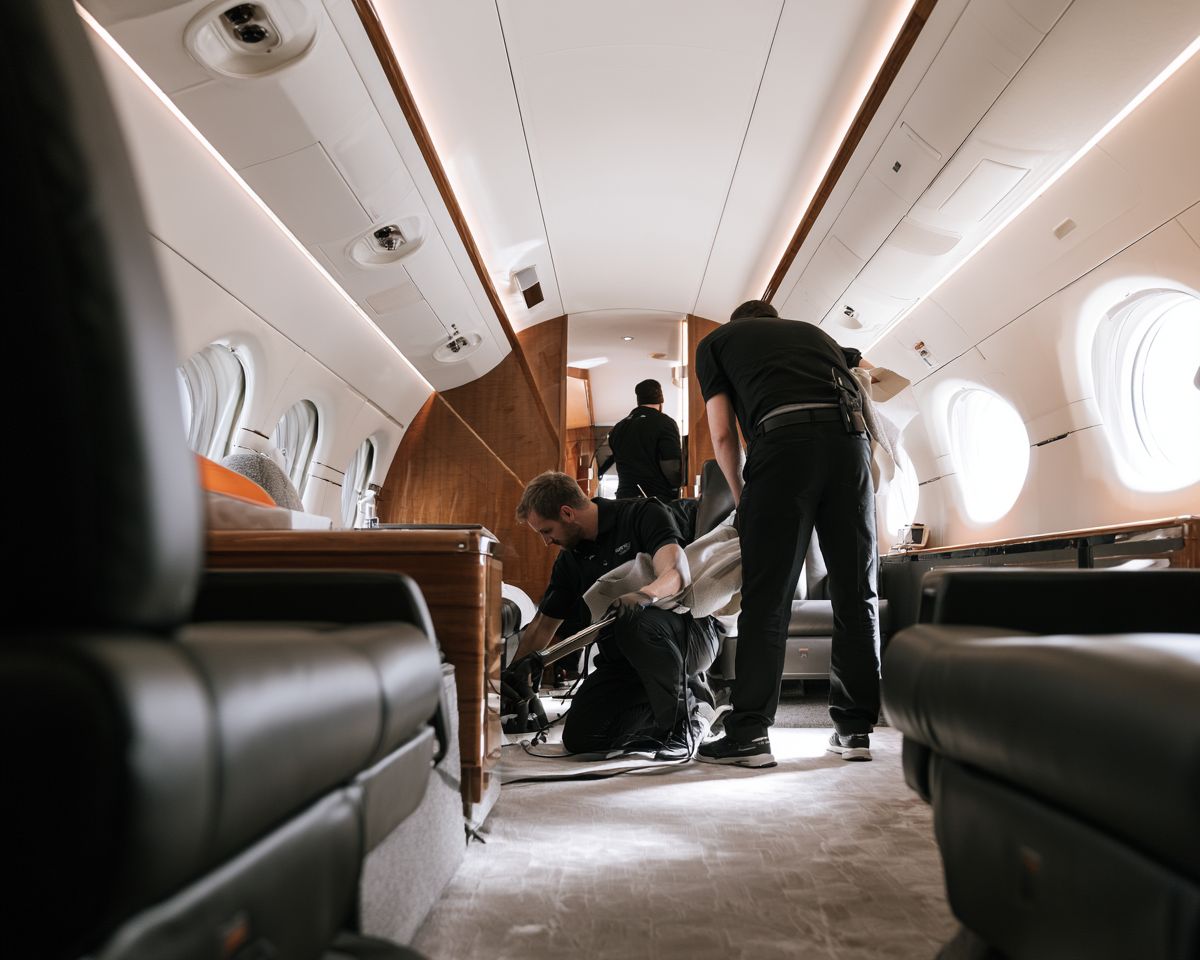
- Interior tidy between legs: cabin reset, galley, trash, glass
These are time-critical, low-risk, and exactly what a responsive line crew is well placed to do. A good FBO doing these things is protecting your asset, and it should be recognized as such.
What should not be asked for is a full exterior wash performed as a favor, compressed into a turn, with uncontrolled media and unrecorded chemistry, on an airframe carrying a coating nobody was told about.
Many FBOs already understand this, which is why the better ones refer detail work out rather than absorb it. That referral is not a lack of capability. It is the same judgment that keeps them from signing off on work outside their scope anywhere else on the field.
One standard, written down
Every service begins with a pre-service inspection and a photographic record, and ends with a completion report. You see the aircraft's condition before anyone touches it and the standard it left in. That record belongs to you, and it is the thing a buyer's representative will want to read in four years.
The Premier Assessment is an honest read on the finish inside and out, in person, and a clear picture of what's achievable. From it you receive a written scope and pricing specific to your aircraft, delivered by email. No obligation. Just the information you need to decide.
Reach us directly. Call (888) 580-9080 · Text (619) 604-9503
© 2026 PREMIER AVIATION VENTURES LLC. All rights reserved. Brown Field Municipal Airport (KSDM) · San Diego, California
Registered office: 1401 21st Street, Suite R, Sacramento, California 95811
Aircraft detailing and appearance services. Ceramic coating certifications as applicable to airframe type. Complimentary assessments offered by appointment.