
Why the cheapest wash is the most expensive
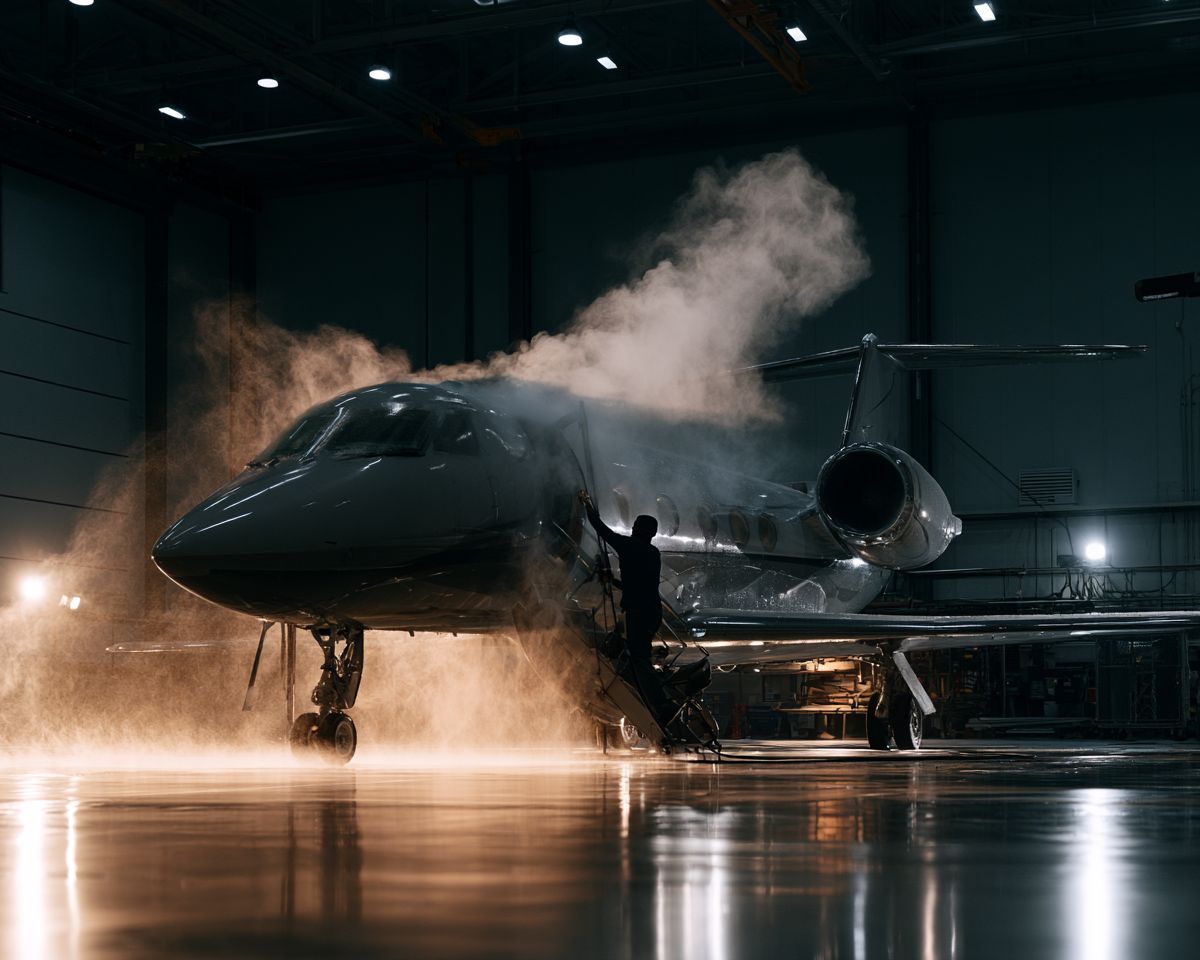
An owner comparing wash quotes is usually comparing the wrong number.
The figure on the invoice is the price. The cost is what the wash consumes. And what it consumes is not replaceable, not visible for about a year, and not itemized anywhere.
Every aircraft paint system arrives from the factory with a finite clearcoat thickness, measured in mils. That thickness is the entire budget. Every machine correction over the life of the airframe draws from it, and when it is gone the only remaining option is a strip and repaint.
A cheap wash does not save money against that budget. It spends it faster.
The consumable nobody puts on a depreciation schedule
Owners track engine hours against overhaul. They track cycles. They track calendar limits on components.
Almost nobody tracks the number of corrections left in the paint.
The mechanism is simple and it is mechanical, not chemical. Contaminated media dragged across a topcoat installs marring: fine directional scratching that hides under hangar light and appears as swirl under direct sun or an inspection lamp. It accumulates invisibly, wash by wash. There is no threshold event and no day it becomes obvious.
Eventually the finish reads flat. Gloss drops, distinctness of image degrades, and the aircraft that used to look wet at fifty feet no longer does. The fix is machine correction, which restores the surface by removing material. The scratches are not filled. The surrounding clearcoat is cut down to their depth.
That is the transaction. Marring is bought at a discount and paid for in mils.
The arithmetic owners rarely run
Set aside absolute figures. Yours will differ by airframe, region, and interval. Run the shape of it instead.
Take two wash programs on the same aircraft over a five-year hold. One is priced at a fraction of the other. Multiply the per-wash difference across the interval and the holding period, and the savings are real and easy to point at.
Now add the other column:
- One additional paint correction across that period, brought forward by the marring load, at multiples of a single wash
- A coating replaced early: protection that was rated for years, stripped by incompatible chemistry inside months, with the second application priced at full cost
- Clearcoat consumed: corrections that are no longer available later in the airframe's life
- The resale adjustment on a finish with no service record behind it
The savings sit in the first year. The costs land in years three through five, in a different budget line, attributed to something else. That is why the arithmetic rarely gets run: the two halves never appear on the same page.
Cheap is not a discount on the same work
This is the assumption worth dismantling.
A wash is priced on labor time. Time is effectively the only variable in the equation, which means a materially lower price buys a materially shorter job. Nothing else can give.
What gets removed to make the number work:
- Passes. Contamination that needs dwell and a second approach gets one quick pass instead.
- Media changes. Fresh mitts and towels cost time to swap and money to launder. A cheap job runs one set across the airframe, and often across the next airframe.
- Rinse discipline. Seams, lap joints, fastener rows, and control surface gaps take deliberate work. They get skipped.
- Controlled drying. The most time-expensive step, and the first cut. Water left to evaporate in sun leaves mineral etching; water left in overlaps is trapped moisture in exactly the faying surfaces where corrosion initiates.
- Documentation. Nobody photographs anything, so nothing can be established later.
You are not buying a lighter version of the same operation. You are buying a different operation that produces a similar result for about a week.
The door only opens one way
Washing is reversible. Do it again next month and nothing is lost.
The damage a bad wash causes is not reversible. Marring cannot be washed out, waxed out, or coated over. A coating applied over marring seals it in and makes it permanent until someone cuts it back. Etching from mineral deposits or uric acid left to sit is topcoat that has been chemically removed. Trapped moisture that has started filiform corrosion under a lap joint is a paint and structure conversation, not a cleaning one.
An owner can recover from underwashing. Recovering from a hundred cheap washes means paying a correction bill and permanently reducing what the paint system can absorb in future.
What to ask before you book one
Price is a poor signal. These questions are better, and they take a minute:
- What chemistry, and at what dilution? A specific product name and a manufacturer ratio, not "aircraft soap."
- Do you know what is currently on this aircraft? A vendor who does not ask whether the airframe is coated, sealed, waxed, or bare is about to guess.
- How is media managed? Two-bucket with grit guards, fresh media per aircraft, and what happens when a mitt hits the ground.
- How is it dried? Controlled drying, or evaporation.
- Where does the water go? A permitted rack with containment, or the nearest storm drain.
- What do I receive afterward? Condition before, condition after, in writing.
A vendor who answers all six cleanly is not the expensive option. They are the one whose price reflects the actual work.
When cheap is genuinely fine
There are cases, and it is worth being straight about them.
An airframe already scheduled into a paint shop inside six months does not need clearcoat preserved. A hull being sold as-is at a discount that already prices the finish does not either. A quick presentation wipe before a photo, on an aircraft with an intact coating doing the protective work, is low risk.
Outside those, the calculation holds. The finish is a depreciating asset with a limited number of recoveries in it, and it is being spent by whoever touches it most often.
Find out what your finish has left
Remaining film thickness, existing marring load, and the condition of whatever protection is currently on the aircraft determine what is worth doing and what is not. None of it reads from a price sheet.
The Premier Assessment is an honest read on the finish inside and out, in person, and a clear picture of what's achievable. From it you receive a written scope and pricing specific to your aircraft, delivered by email, including anything we recommend against, and why. No obligation. Just the information you need to decide.
Reach us directly. Call (888) 580-9080 · Text (619) 604-9503
© 2026 PREMIER AVIATION VENTURES LLC. All rights reserved. Brown Field Municipal Airport (KSDM) · San Diego, California
Registered office: 1401 21st Street, Suite R, Sacramento, California 95811
Aircraft detailing and appearance services. Ceramic coating certifications as applicable to airframe type. Complimentary assessments offered by appointment.