Spray ceramic vs. full ceramic: which one does your aircraft need?
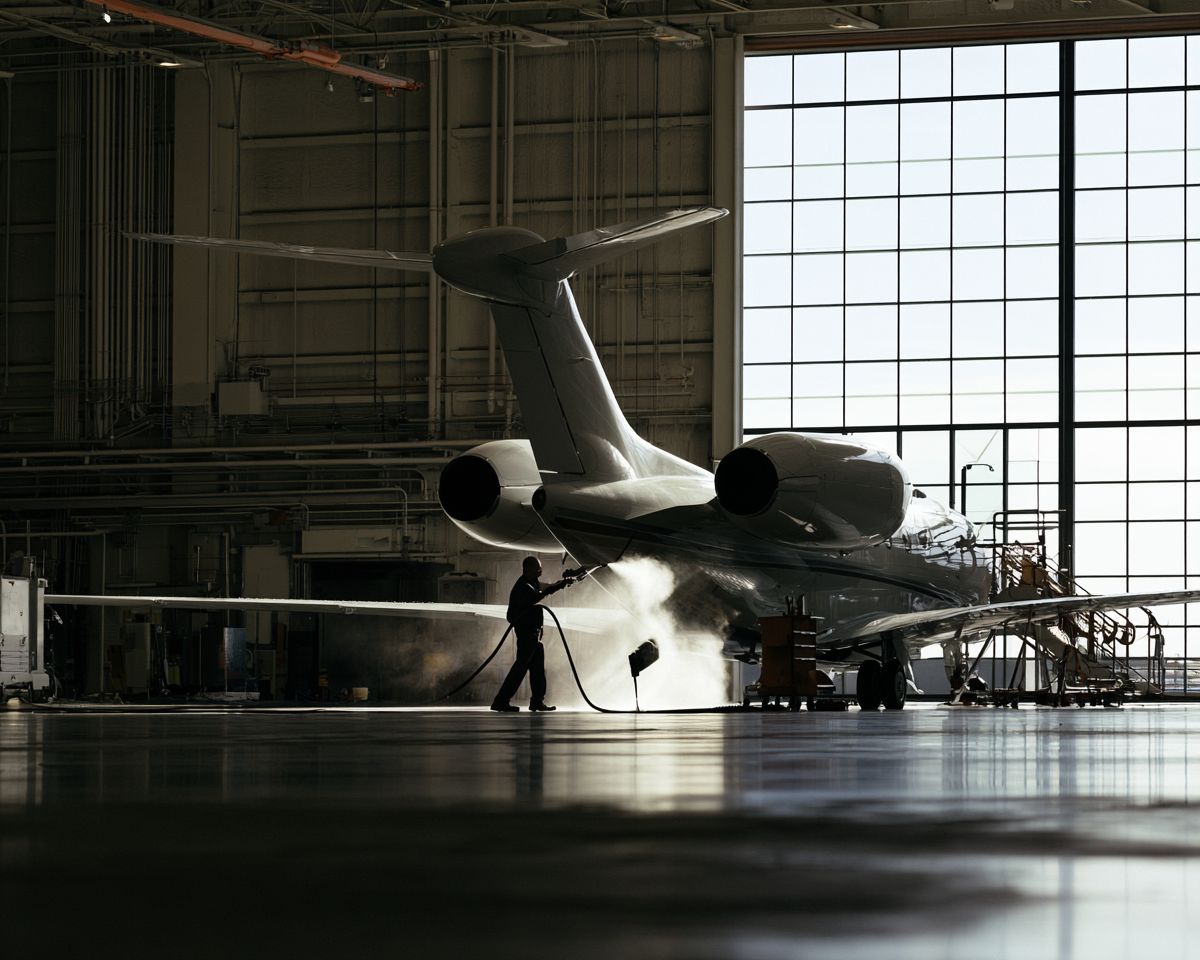
This is the most common pre-purchase question in aircraft surface protection, and it is usually asked in the wrong order.
Owners want to know which coating to buy. The question that determines the outcome is whether the surface underneath is ready to be sealed at all. A coating locks in whatever is beneath it, faithfully, for as long as it lasts.
A correct coating over a compromised finish is an expensive way to make a problem permanent. Getting the sequence right matters more than getting the product right.
What both of them actually are
Both are silica-based chemistry that cross-links to the paint surface through covalent bonding rather than sitting on top of it as wax does. The result is a hard, hydrophobic, chemically resistant layer that becomes part of the surface system.
What that layer does:
- Sheds contamination rather than letting it embed. Exhaust soot, insect residue, industrial fallout, and salt sit on the coating instead of bonding into the topcoat.
- Resists chemical attack. Uric acid and mineral deposits get a barrier to cut through first, which frequently means a wash removes what would otherwise have become etching.
- Slows UV degradation by taking the ultraviolet load that would otherwise reach the resin.
- Holds gloss and distinctness of image far longer than an additive layer.
- Makes every subsequent wash easier and safer, which quietly reduces the marring load over the life of the paint. This is the benefit owners underestimate most.
Neither product is a different category from the other. The difference is interval.
The honest difference: duration, not quality
Spray ceramic is engineered to protect for several months. Full ceramic is engineered to protect for years.
Shorter-lived does not mean lighter-duty. The chemistry bonds to the paint in the same way. Removing spray ceramic early means abrading it off, the same as the full system. It is not a temporary product in any sense that matters to the paint.
What differs is film build, application process, and preparation depth. The full system asks more of the surface before it goes on and delivers a longer service life once it is there.
Where spray ceramic genuinely fits
Spray ceramic is the right call in four situations:
- The aircraft is flying hard. High utilization, frequent legs, an airframe that accumulates exposure faster than a coating interval can be planned around comfortably.
- You are holding a standard between more substantial work. Paint that will be corrected or repainted inside a year or two, and needs protecting until then.
- You want to see how a coating performs before committing. This is a legitimate reason and worth stating plainly. Coatings change how an aircraft is washed and how often. Trying that at a shorter interval before committing to the long system is sound judgment.
- Correction is not currently advisable. Where remaining film thickness will not support a cut, protecting what is left is the better use of money than pursuing a gloss that is not recoverable.
What it will not do is fix paint that needs correcting first. If the surface needs work, that work comes first.
Where full ceramic fits
The full system suits an airframe at a particular moment:
- Just painted. A fresh finish, once cured, is the ideal substrate. There is nothing to correct and nothing to lock in.
- Just corrected. Coating immediately after correction preserves the result you paid for, rather than letting it be re-marred over the next eighteen months.
- Set up for a long hold. Where the ownership horizon is years rather than months, the longer interval is straightforwardly better economics.
Preparation is most of the job
This is the part that separates a coating that performs from one that disappoints, and it is where the cost actually sits.
A coating locks in whatever is underneath it. Decontamination and correction come first and are not optional.
- Paint decontamination removes bonded contamination that washing will not lift. Coating over it seals it against the paint permanently.
- Correction addresses marring, oxidation, and etching. Coating over defects makes them the finish for the life of the coating.
- Surface preparation removes residual oils and polishing residue so the chemistry can bond. Skip it and the coating fails early in ways that look like product failure and are not.
An operator who quotes a coating without inspecting the surface first is quoting an application, not an outcome. A coating on a properly prepared surface is a long-term asset. The same product on an unprepared one is a sealed-in problem with a warranty attached.
We will tell you if the surface is not ready, and we would rather lose the booking than bond a coating over defects.
A fixed rule: not on windows
Coatings are not applied to pressurized windows or jet glass. That is a fixed rule at Premier, not a preference, and it does not move for any aircraft.
If a vendor offers to coat your transparencies, that is a useful signal about the rest of their judgment.
Both are irreversible. What that means for you
Neither coating is reversible. Removing either one means abrading it off the paint, which draws on the same finite clear coat budget that every correction draws on.
That is why both are booked as irreversible work, with lead time, insurance and deposit requirements ahead of the date. Many shops treat spray ceramic casually because it is the shorter-interval product. The chemistry does not care about the interval.
The friction is deliberate. It means somebody has confirmed the paint can take it before anything is applied.
Cure conditions are not a detail
Coatings cure. That is the whole point of them, and it is why the environment they cure in matters.
Temperature affects cross-link rate. Humidity affects it. Airborne particulate that settles during cure becomes part of the coated surface permanently. A coating applied on an open ramp in wind, or rushed to meet a departure, will not perform the way the same product performs under managed conditions.
Where hangar space is available, at Brown Field or at your aircraft's home base with your FBO, we work indoors, with steady temperature, managed humidity and filtered air, and with the cure time the manufacturer specifies rather than the time the schedule would prefer.
A quoted cure window shorter than the manufacturer's is not efficiency.
What neither one does
Both products are frequently oversold, so it is worth being direct.
A coating does not make an aircraft self-cleaning, does not eliminate washing, and does not make paint impervious. Contamination still lands. It sits on the coating rather than embedding, which is exactly why it must still be removed. An unwashed coated aircraft is holding acidic deposits against your paint very efficiently.
A coating also does not stop a bird strike from etching if it is left in the sun long enough, does not repair anything, and does not eliminate the need to inspect seams and faying surfaces where the real corrosion risk lives.
How to decide
- Freshly painted or freshly corrected, long hold ahead → full ceramic
- Flying hard, or protecting a finish until scheduled work → spray ceramic
- Paint needs correction and film thickness supports it → correct first, then coat
- Paint needs correction and film thickness does not support it → spray ceramic over a properly decontaminated surface
- Unsure how a coating changes your maintenance routine → spray ceramic first is a reasonable, honest way to find out
Structure type also bears on product selection. Metal and composite airframes behave differently and are not automatically candidates for the same system. That is a conversation to have about your specific aircraft rather than a rule to read off a page.
The surface decides, not the brochure
Remaining film thickness, existing defect load, contamination bonded into the paint, and how the aircraft actually flies determine which coating is appropriate. They also decide whether correction needs to happen first.
The Premier Assessment is an honest read on the finish inside and out, in person, and a clear picture of what's achievable. From it you receive a written scope and pricing specific to your aircraft, delivered by email, including the sequence of work and anything we recommend against. No obligation. Just the information you need to decide.
Reach us directly. Call (888) 580-9080 · Text (619) 604-9503
© 2026 PREMIER AVIATION VENTURES LLC. All rights reserved. Brown Field Municipal Airport (KSDM) · San Diego, California
Registered office: 1401 21st Street, Suite R, Sacramento, California 95811
Aircraft detailing and appearance services. Ceramic coating certifications as applicable to airframe type. Complimentary assessments offered by appointment.